CCTV System Philippines Buyer's Guide: Specs and the Law
Published: August 10, 2026 | Last Updated: August 10, 2026
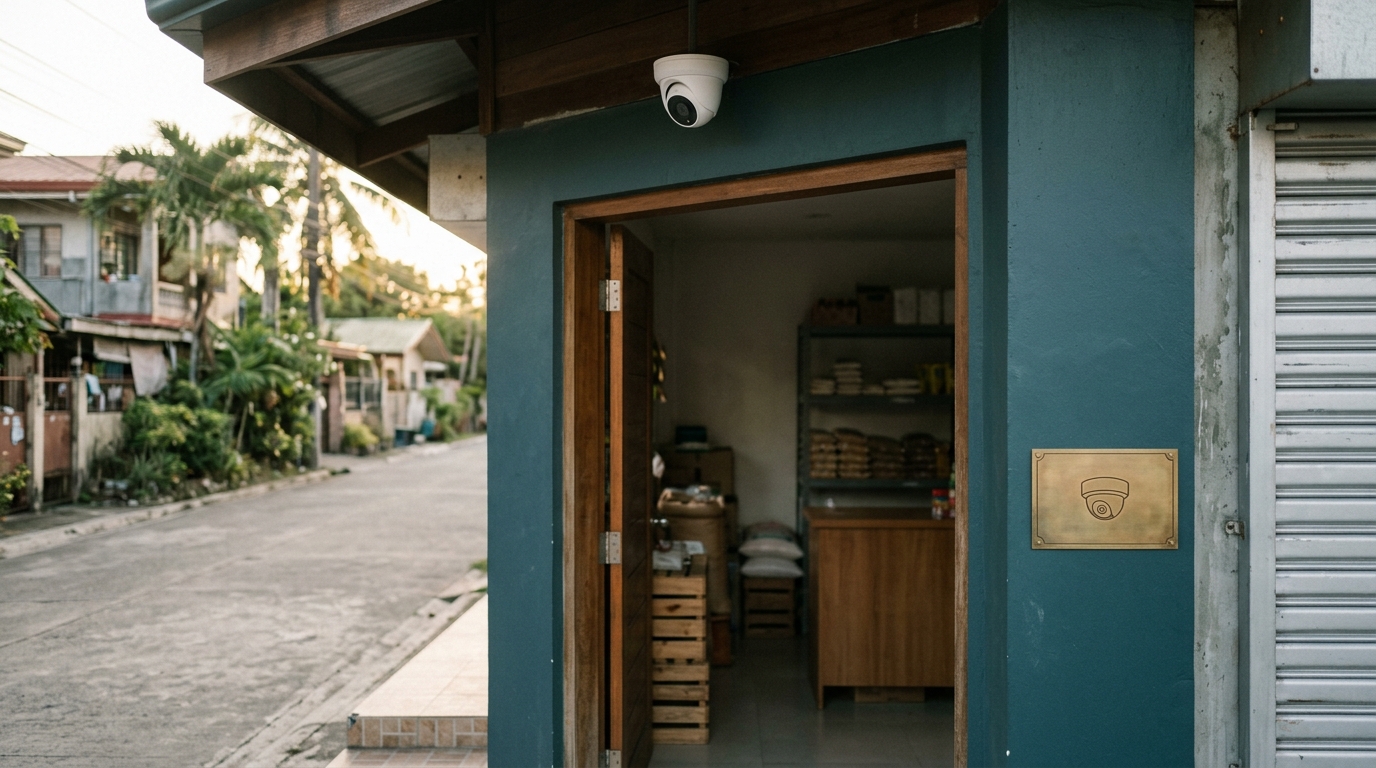
Quick Answer
- If your cameras capture people anywhere beyond a purely private residence, including the street outside your own gate, NPC Circular 2024-02 applies to you, and you are responsible for the footage under the Data Privacy Act.
- Resolution is meaningless without a distance. The industry standard, DORI, sets four thresholds, and one camera can detect a person at 80 meters but only identify one at 8 meters. Buy against the distance you need, not the megapixel number.
- IP66 and IP67 are not a ladder. Both are fully dust-tight, and they are tested against different water hazards, powerful jets versus brief immersion, so the right one depends on where the camera sits.
Buying a CCTV system in the Philippines comes down to three questions in order: whether the law treats you as responsible for the footage, what each camera has to be able to resolve at the distance it is actually mounted, and whether the equipment survives the local climate. Camera shape and megapixel count, which is where most buying guides start, follow from those answers rather than leading them. The reason to work in that order is practical. A camera bought for the wrong distance produces footage nobody can use, and a system bought without the legal obligations in mind can be perfectly good hardware that still cannot do what you are required to do with it.
Table of Contents
Does Philippine Law Apply to Your CCTV System?
What Does NPC Circular 2024-02 Actually Require?
How Much Camera Resolution Do You Actually Need?
Which Camera Type Belongs in Which Location?
What Kind of Night Vision Should You Buy?
Do You Need Local Recording, Cloud, or Both?
What Weatherproof Rating Does a Philippine Installation Need?
Which Features Does Compliance Require You to Buy?
Does Philippine Law Apply to Your CCTV System?
If your cameras record identifiable people in any public or semi-public space, yes. That covers essentially every business, and it covers more homes than most homeowners expect.
The rule is NPC Circular No. 2024-02, issued by the National Privacy Commission on 9 August 2024 and in force since 27 August 2024, which replaced the earlier NPC Advisory No. 2020-04 from 2020. It applies to anyone the Data Privacy Act calls a personal information controller, meaning the person or organization that decides why and how personal data gets collected. If you own the cameras and decide what they point at, that is you.
A semi-public space, in the Circular's own definition, is any indoor or outdoor space that is privately owned but open to the public during operating hours. A shop floor is one. A clinic waiting room is one. A restaurant, a gym, a building lobby, a covered parking area: all semi-public. So a business is inside the scope from the day the first camera goes up.
The part that catches homeowners. The Circular does exempt CCTV used for purely personal, family, or household affairs, which is where most local guides stop. It then goes on to say that where a system captures images of individuals beyond the boundaries of a private, non-commercial residence, and particularly where it monitors a public space, that use cannot be considered purely personal, and the owner becomes a personal information controller with the corresponding obligations. A camera mounted over a gate that takes in the street, the sidewalk, and the neighbor's frontage is doing exactly that. It is a common way to mount a residential camera in the Philippines, and it is the difference between being exempt and not. Angling the camera to cover your own property rather than the road is a purchasing and installation decision with a legal consequence attached, which is why it belongs in a buying guide rather than in the fine print afterwards.
What it means for you: before you shortlist anything, walk the property and note which cameras will see beyond your own boundary. That list tells you whether you are buying a household system or a system you are legally accountable for, and the two are specified differently.
What Does NPC Circular 2024-02 Actually Require?
Five principles, and a set of operating rules underneath them. None of it requires a lawyer to read, and several parts affect what you buy.
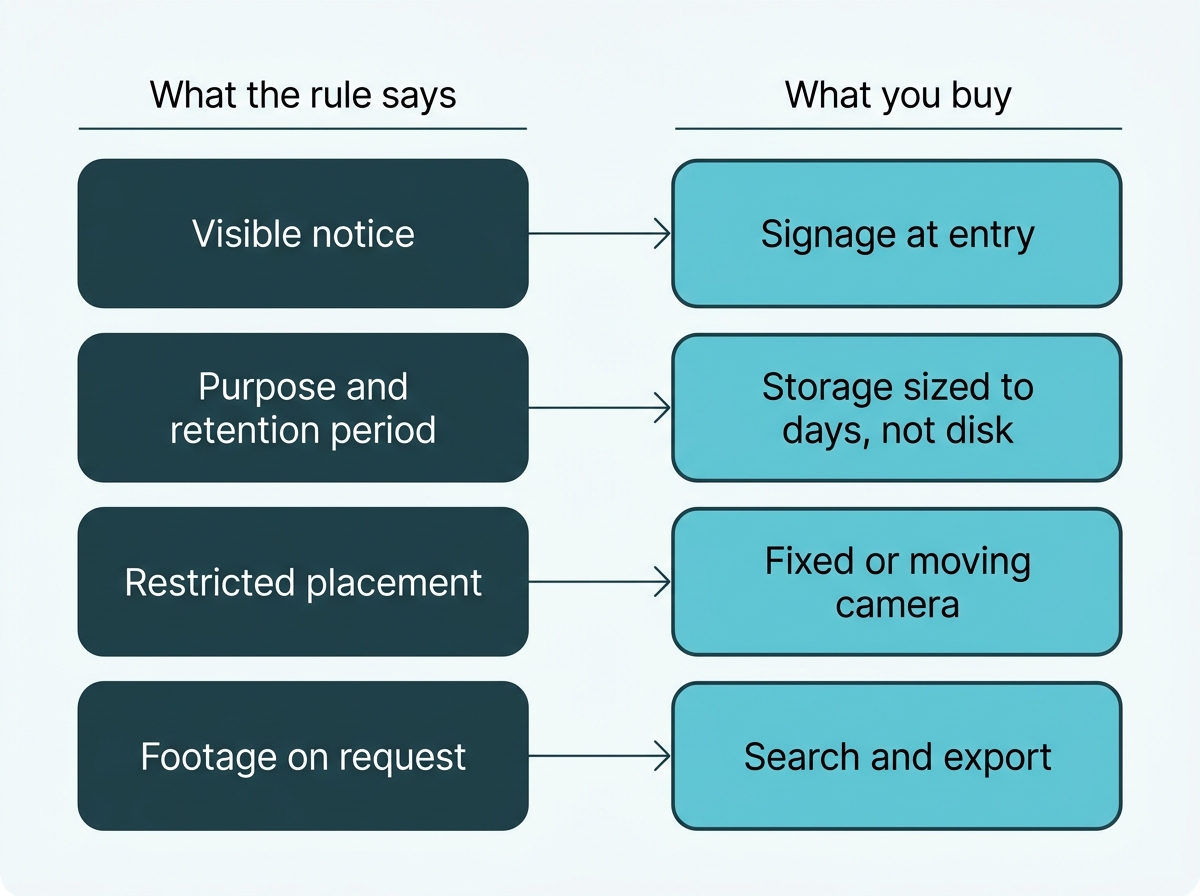
The five general principles in Section 3 are transparency, legitimate purpose, proportionality and data minimization, fairness and lawfulness, and accountability. In practice: post a visible notice that cameras are operating, be able to say clearly why they are there, point them only where that purpose requires, do not use the footage to single people out unfairly, and stay answerable for the recordings, including when a third party manages them for you.
Three operating rules matter more than the principles when you are choosing hardware.
Some places are simply off limits. The Circular prohibits CCTV in areas where people have a heightened expectation of privacy, naming fitting rooms, rest rooms, toilets, and lactation or breastfeeding rooms. That is a hard stop, not a proportionality judgment.
Moving cameras carry an extra condition. Where a camera can pan, tilt, or zoom, the Circular requires that those functions not end up surveilling private spaces, such as a neighboring backyard or the windows of a private residence. A pan-tilt camera is a good choice for a wide forecourt and a liability on a tight urban lot with houses on three sides, and that is a decision made at purchase.
Retention is not a storage question. The Circular sets no fixed retention period. It requires that footage be kept only as long as the declared purpose needs, that the period be documented in a written CCTV policy, that footage be destroyed once it is no longer needed, and specifically that retention periods must not be determined solely by the storage capacity of the system. That last line inverts the usual buying logic. The common approach is to buy a recorder, see how many days it holds, and call that the retention period. The Circular asks you to decide the period first and then buy storage that fits it.
Violations carry criminal, civil, and administrative liability under the Data Privacy Act, per Section 12 of the Circular. The Circular itself sets no separate penalty schedule.
What it means for you: decide two things on paper before you shop: the purpose each camera serves and how many days of footage that purpose needs. Those two answers size your storage, rule some camera positions in or out, and are also the two things you would be asked for first if anyone ever queried the system.
How Much Camera Resolution Do You Actually Need?
Enough to resolve the detail you need at the distance the camera is mounted. Megapixels alone cannot answer this, because the same camera delivers wildly different detail at 8 meters and 80 meters.
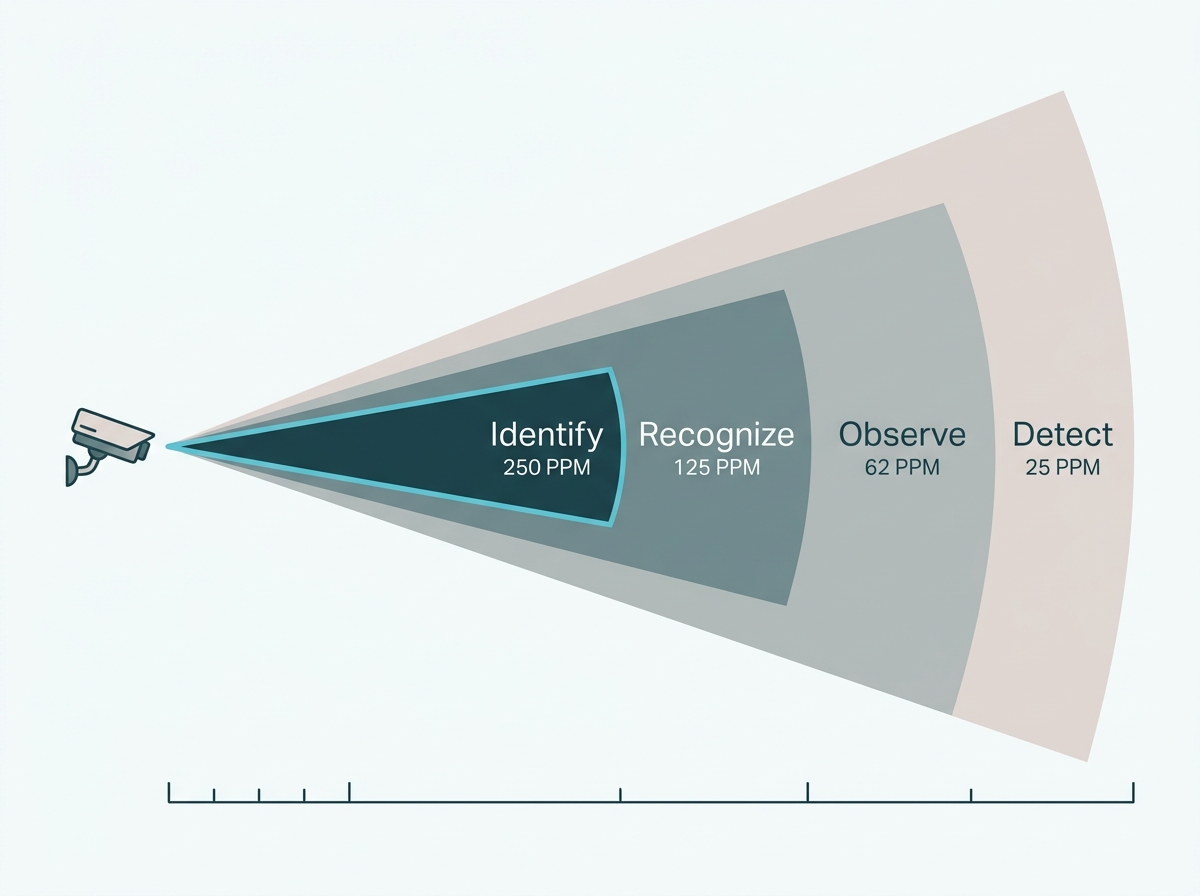
The surveillance industry has a standard for exactly this, and it is worth knowing because it is printed on the datasheets already. It is called DORI, from the international standard IEC EN 62676-4:2015, and it names four levels of detail measured in pixels per meter across the scene: detection at 25 pixels per meter, meaning you can tell a person or vehicle is there; observation at around 62, meaning you can make out clothing and general activity; recognition at 125, meaning you can tell whether someone is a person you have seen before; and identification at 250, meaning you can identify a stranger with confidence.
The gap between those levels is much larger than it sounds. Take a published example: the VIGI C540, a 4MP pan-tilt camera with its 4 mm lens, is listed at detect 80 meters, observe 33 meters, recognize 16 meters, identify 8 meters. Same camera, same sensor, same night. The distance at which it can identify a face is one tenth of the distance at which it can tell you someone is there.
This is the mechanism behind a complaint that comes up constantly after a break-in: that the footage was 4K but nobody could tell who it was. The resolution was real. The subject was standing at observation distance, not identification distance.
So the useful order is: pick the spot, measure how far the subject will be from it, decide whether you need identification or only detection there, then choose a camera and lens whose published DORI figures cover it. A gate where you need to know who is at the door needs identification within a few meters. A yard where you only need to know something moved can run detection at forty. Buying one camera specified for both usually means overpaying at one end and underperforming at the other.
What it means for you: for each camera position, write down the distance to the subject and whether you need to identify a stranger or just see that something happened. Take that list shopping, and compare it against published DORI figures rather than against megapixel counts.
Which Camera Type Belongs in Which Location?
The form factor follows the space, and the shortlist is short. Dome cameras suit indoor retail and offices, because the housing is discreet and it is hard to tell which way the lens points. Bullet cameras suit outdoor perimeters and entrances, where the long body gives clear directional coverage and is visible enough to serve as a deterrent. Turret cameras sit between the two and are easier to re-aim than a dome. Pan-tilt cameras cover large open areas such as yards and parking from a single unit, subject to the placement restriction covered above.
That is the whole decision at buying-guide depth. If you want the form factors compared properly, along with lens types, sensors, and the features that vary within each shape, our guide to choosing the right camera for the space covers it in detail.
What it means for you: decide form factor last, not first. The distance and detail requirement from the previous section rules out more options than the shape of the housing does.
What Kind of Night Vision Should You Buy?
It depends on whether you need to know something happened at night or need to identify who. Three different technologies answer those differently, and they are often described with the same phrase on retail listings.
Infrared night vision uses invisible IR illumination and produces black-and-white footage. It is unobtrusive, costs the least, and is fine when you need to see that a gate opened. It cannot give you the color of a shirt or a vehicle.
Conventional full-color night vision keeps color after dark by running supplemental white light. You get usable color detail, at the cost of a lit-up frontage all night and the power that goes with it.
VIGI ColorPro Night Vision takes a different route, using a large aperture and a high-sensitivity sensor to capture full color in ultra-low light without needing supplemental lights at all. That suits places where a permanently lit facade is unwelcome, such as a residential street or a hotel frontage.
VIGI LightPro Night Vision is the switching approach. The camera runs infrared most of the time and turns the white light on only when it detects a person or a vehicle, so color detail arrives when there is something to see, and the light stays off the rest of the night.
Published infrared and white light ranges, such as the 30-meter figures on several VIGI models, are manufacturer figures measured under ideal conditions. Treat them as a comparison between models rather than as a distance guarantee in a specific yard, because reflectivity, rain, and ambient light all cut into them. For a fuller comparison of night vision options and where each suits, see our guide to picking a night vision camera.
What it means for you: ask what you would need the night footage to prove. If the answer involves color, infrared alone will not deliver it, and the choice is then between lighting the area all night or paying for a sensor that does not need you to.
Do You Need Local Recording, Cloud, or Both?
Local recording keeps working when the internet does not. Cloud keeps a copy when the recorder itself is stolen or damaged. Many systems end up using both, for exactly those two reasons.
A network video recorder, or NVR, is the box that stores footage on hard drives at the property. Because it is on-site, recording continues through an internet outage, which matters in areas where connectivity is not dependable. Several VIGI NVR models also supply power to the cameras over the same network cable, which reduces the wiring. The weakness is physical: if the NVR is stolen along with everything else, the evidence goes with it. Cloud or off-site storage covers that gap, and also makes several branches viewable from one place without visiting each.
The sizing math, meaning how many terabytes a given number of cameras at a given resolution needs for a given number of days, is covered in our guide to choosing a surveillance video recorder.
One input into that math changes if you are a business. As covered above, the Circular requires the retention period to be documented and to be set by purpose rather than by the capacity that happens to be in the box. So the sizing runs in the other direction from the usual: start from the number of days your stated purpose actually needs, then buy the capacity that holds it, and configure the system to delete on schedule rather than to overwrite whenever it happens to fill up.
VIGI publishes an online capacity calculator that runs the arithmetic both ways, giving either the storage a set period consumes or the number of days a given disk holds. It takes resolution, bit rate, encoding type including H.264 and H.265, whether smart encoding is on, and the number of cameras. The same calculator is built into the VIGI app. Run it with your retention period as the input rather than with the disk size you were already considering, and treat the output as guidance rather than a guarantee, since the tool states its results are for reference only.
What it means for you: decide your retention period in days before you look at a single recorder, then treat that number as the input to the storage calculation. It is also the number you would need to produce if the system were ever queried.
What Weatherproof Rating Does a Philippine Installation Need?
One that matches the specific hazard at the mounting point, which for most Philippine installations means wind-driven rain rather than flooding. IP66 and IP67 are not a ranking, and treating them as one leads to buying the wrong protection.
IP stands for ingress protection, defined by the international standard IEC 60529. The first digit covers solids, the second covers water. In IP66 and IP67, the first digit is identical: both are completely dust-tight. The second digit describes two different tests. The 6 in IP66 means tested against powerful water jets from any direction. The 7 in IP67 means tested against immersion in up to one meter of water for thirty minutes, and it is not tested against powerful jets.
For a camera under an eave taking horizontal rain off a typhoon, the jet test is the relevant one. For a camera mounted low in an area that floods, the immersion test is relevant. Neither rating is the premium version of the other, which is why VIGI's own range includes both, with models like the C540 rated IP66 and models like the C320I rated IP67. Our guide to the difference between IP66 and IP67 goes through where each belongs.
The rating is only half of outdoor durability in this climate anyway. Sustained humidity and heat work on cable entries, gaskets, and connector seals, which is where outdoor cameras usually fail first, well before any electronic component wears out. A correctly rated camera installed with the supplied waterproof cable attachments left in the box is not a weatherproof installation.
What it means for you: for each outdoor position, name the hazard before you name the rating. Rain and wind mean IP66 is the relevant test. Standing water or flood risk means IP67. And budget the sealing accessories rather than assuming the housing does all the work.
Which Features Does Compliance Require You to Buy?
Four capabilities, and they are easy to miss on a spec sheet because none of them appears in the headline features. This is the part of the purchase that most buying guides skip entirely.
Privacy masking. Because the Circular requires cameras to monitor only the intended space, and forbids pan-tilt-zoom functions from being used to look into private spaces, a camera that covers a shared frontage often needs parts of its own field of view permanently blocked out. That is a feature called privacy masking, and it is a per-model specification. VIGI cameras such as the C540 support up to four masked regions. If a camera cannot mask, the only remedy left is moving it.
Encrypted storage with restricted access. The Circular requires recorded footage to be stored securely and encrypted in line with NPC issuances, requires access to the stored footage to be limited to named authorized personnel, and requires access logs covering viewing, copying, and transfers to be kept up to date. So a system needs user accounts with real permission levels and an access log, not a single shared password everyone in the office knows.
Search and export by time and place. When someone requests footage of themselves, the Circular gives you five working days to arrange a viewing and fifteen working days to supply a copy, extendable once by up to a further fifteen. Meeting that means being able to find a specific date, time, and camera quickly and export it intact with its metadata. A system that can only be reviewed by scrubbing through days of recording on a screen at the site is a system that will miss those deadlines.
A privacy assessment if you use video analytics. The Circular defines video analytics to include artificial intelligence algorithms and facial recognition, and requires a privacy impact assessment to identify and reduce the risks where those are in use. VIGI features such as human and vehicle classification and people counting fall into this category. They are worth buying where they cut false alarms, and they come with an assessment obligation attached rather than one.
What it means for you: add these four to your shortlist criteria alongside resolution and weatherproofing. They cost nothing extra to specify at purchase, and they are expensive to retrofit, because the remedy for a camera that cannot mask or a recorder that cannot log access is usually replaced.
To see the camera range and the specifications behind these features, browse VIGI cameras, or explore VIGI's surveillance solutions for complete systems.
Frequently Asked Questions
Is it legal to install CCTV cameras in the Philippines?
Yes. Businesses and organizations recording identifiable people in public or semi-public areas must follow NPC Circular No. 2024-02, in force since 27 August 2024, which requires visible notice, a declared legitimate purpose, proportionate coverage, and documented handling of the footage. Violations carry criminal, civil, and administrative liability under the Data Privacy Act.
Do the CCTV rules apply to a private home?
Not if the system is purely for household use within the boundaries of the property. But NPC Circular 2024-02 states that where a home system captures people beyond those boundaries, particularly where it monitors a public space such as the street, the owner is treated as a personal information controller with the full obligations that follow. A camera angled to cover the road usually crosses that line.
What camera resolution do I need for a CCTV system?
It depends entirely on distance. The DORI standard, from IEC EN 62676-4, sets four levels: detection at 25 pixels per meter, observation at 62, recognition at 125, and identification at 250. One 4MP camera can detect a person at 80 meters but identify one only at around 8, so match the published DORI figures to the distance at each position rather than comparing megapixel counts.
Is IP67 better than IP66 for an outdoor camera?
No, they protect against different things. Both are completely dust-tight; IP66 is tested against powerful water jets from any direction, and IP67 is tested against brief immersion in one meter of water but not against jets. For wind-driven rain, IP66 is the relevant test. For a low mounting point in a flood-prone area, IP67 is.
How long do I have to keep CCTV footage in the Philippines?
NPC Circular 2024-02 sets no fixed period. It requires footage to be kept only as long as the declared purpose needs, the period to be written into a documented CCTV policy, and the footage to be destroyed once that purpose ends. It also states that the retention period must not be decided solely by how much storage the system happens to have.
Should I choose local NVR storage or cloud storage?
Many systems use both. Local recording on a network video recorder keeps running during an internet outage, while cloud or off-site copies survive the recorder being stolen or damaged and make several sites viewable from one place. Whichever you choose, size the capacity to the retention period you have decided on rather than the other way round.
What is privacy masking and do I need it?
Privacy masking blocks out chosen parts of a camera's field of view so they are never recorded, and it is specified per model, with VIGI cameras such as the C540 supporting up to four masked regions. It matters because NPC Circular 2024-02 requires cameras to monitor only the intended space, so any camera whose view unavoidably takes in a neighboring property or a private window needs it.
Final Thoughts
A CCTV purchase in the Philippines is decided by three things that rarely appear in a product comparison: whether the footage makes you legally responsible for it, what each camera can actually resolve at the distance it will be mounted, and which weather hazard the housing has to survive. Get those right, and the rest of the specification follows. Get them wrong, and you can spend well and still end up with recordings that are unusable, or a system that works perfectly and does not meet an obligation you did not know you had.
The two that cost the most to fix later are distance and masking. A camera bought for the wrong distance cannot be corrected in software, and a camera that cannot block part of its own view has to be moved or replaced. Both are decided in the fifteen minutes before you order.
If you want the shortlist checked before you buy, bring three things to a VIGI specialist: a list of every camera position with the distance to the subject and whether you need to identify a stranger there, the number of days of footage you have decided your purpose needs, and a note of which positions see beyond your own boundary. You will get back a camera and lens recommendation matched to those distances, a storage figure sized to your retention period rather than to a disk size, and a flag on any position where masking or a different weather rating is going to be necessary.