Outdoor Security Camera Types and the Features You Need
Published: September 30, 2026
Quick Answer
- Most business exteriors need two outdoor camera types: bullet cameras for long, narrow views like driveways and fence lines, and turret cameras for wide, close views like entrances and parking bays.
- IP66 weatherproofing is the working minimum for any outdoor camera in the Philippines, with IP67 for low mounts near flood-prone ground and IK10 wherever someone can reach the camera.
- Color night vision, smart detection, and PoE power decide whether an outdoor camera still gives usable footage after two typhoon seasons.
The right outdoor camera starts with the view you need, then survives the weather it lives in. An outdoor camera here bakes in April, takes habagat rain in August, and rides out typhoon gusts a few times a year. This guide covers the outdoor types worth knowing, focusing on VIGI bullet and turret models, plus the ratings, night vision, and mounting details that keep them working.
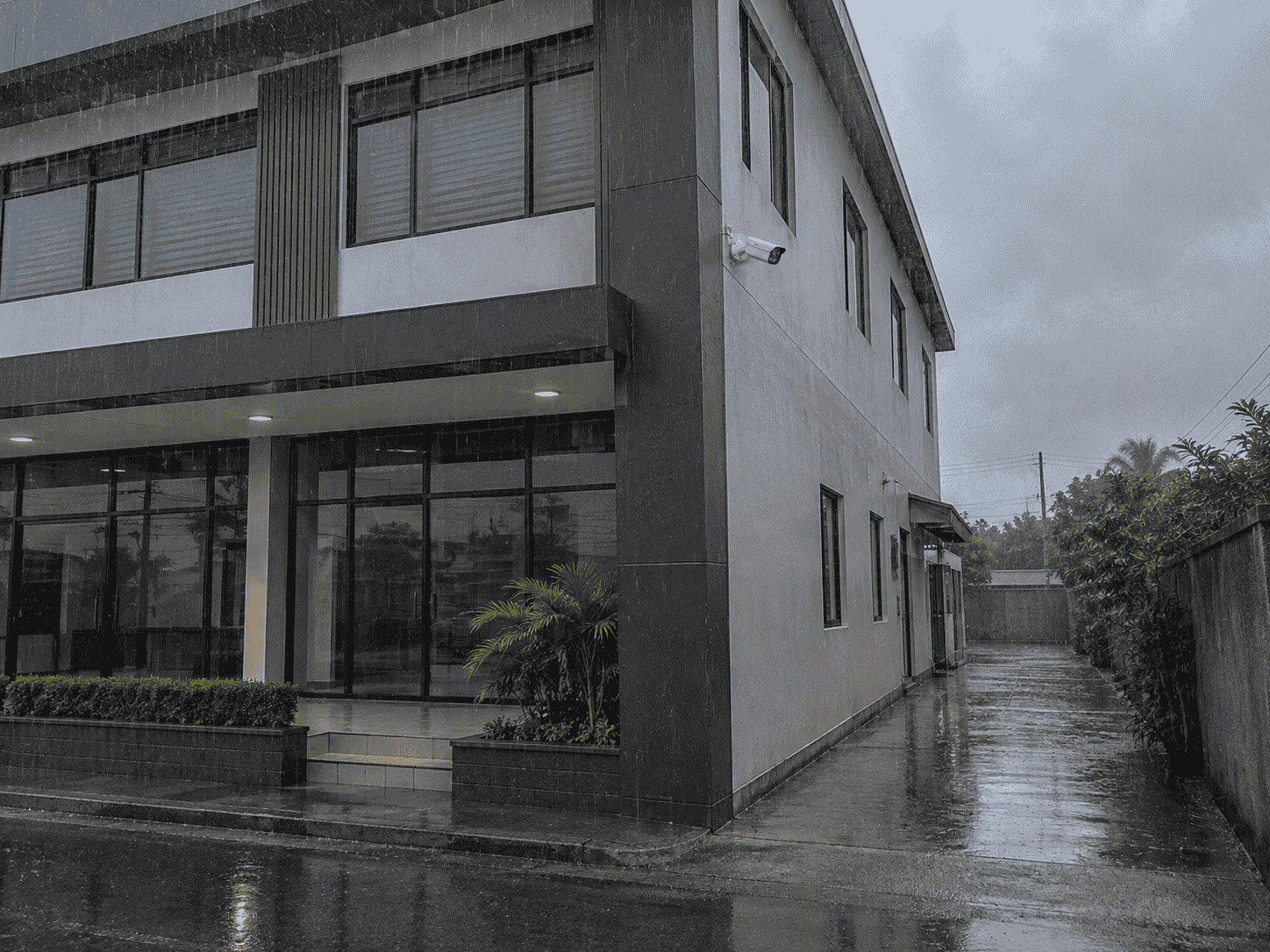
Table of Contents
How Does Philippine Weather Affect Outdoor Cameras?
When Should You Choose a Bullet Camera?
When Should You Choose a Turret Camera?
Which Other Outdoor Camera Types Are Worth Knowing?
Which Weather and Impact Ratings Do You Need?
What Night Vision Works Best Outdoors?
Which Features Should Every Outdoor Camera Have?
How Should You Mount and Cable Outdoor Cameras?
How Does Philippine Weather Affect Outdoor Cameras?
It tests every seal on the housing. PAGASA records an average of 20 tropical cyclones in the Philippine Area of Responsibility each year, with 8 or 9 crossing the country. Nearly 70% of typhoons develop between July and October.
That means months of wind-driven rain hitting housings from angles a brochure never shows. Add near-constant humidity, salt air in coastal towns, and summer roof temperatures that make metal too hot to touch. Cheap housings crack, gaskets shrink, and moisture creeps in behind the lens.
The government has set a floor too. When the DILG urged LGUs to adopt "no CCTV, no business permit" ordinances, the recommended specs from the PNP Anti-Cybercrime Group called for vandal-proof outdoor cameras in IP66 weatherproof casings. Treat IP66 as your starting point, not your finish line. For resolution, budgets, and the legal side, see the complete buying guide for outdoor cameras.
When Should You Choose a Bullet Camera?
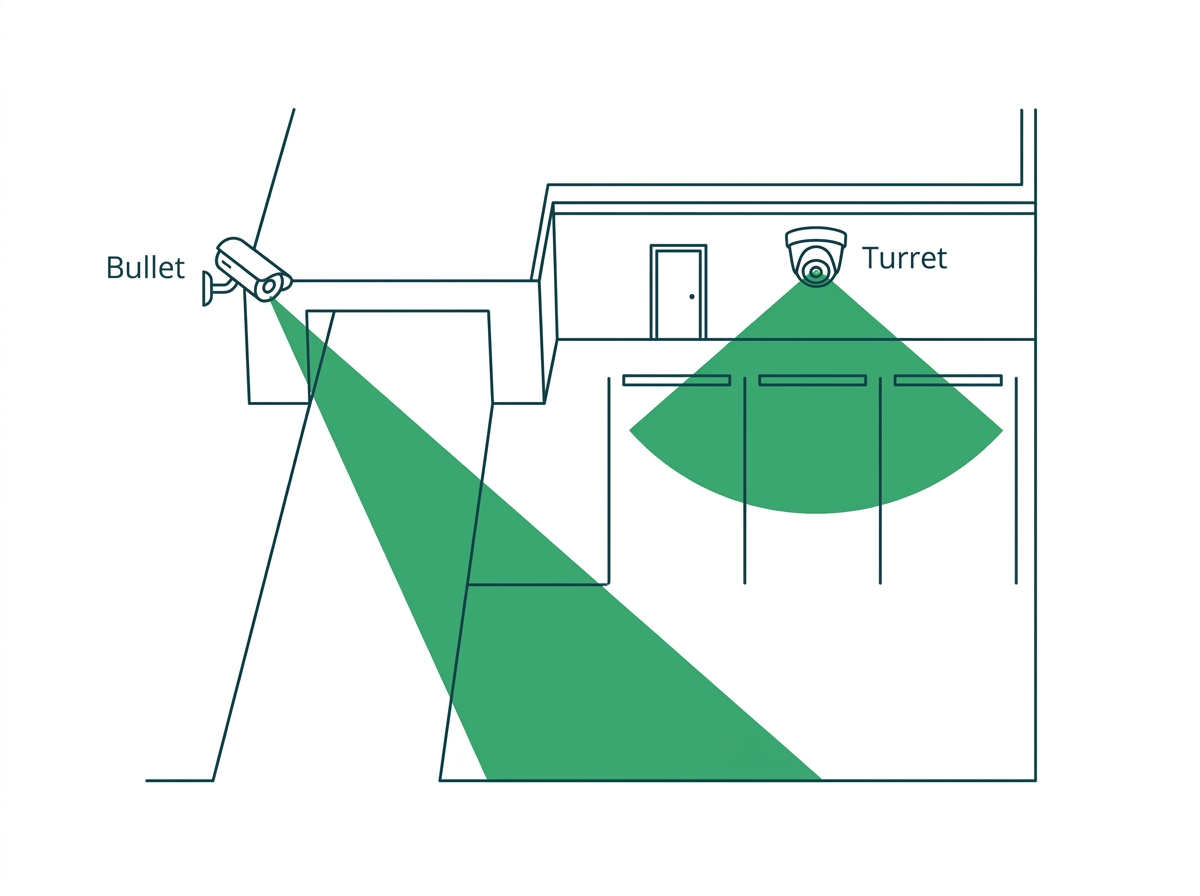
Choose a bullet when the view is long and narrow. A bullet camera is a cylinder on a mounting arm that points one way and sees far.
Where it fits: driveways, perimeter fences, long walls, parking lanes, and the stretch between your gate and your door. The narrow housing takes a longer lens without the body getting in the way.
Why owners like it: everybody recognizes a bullet camera. Would-be thieves see it and move on, which is half the reason many stores mount one over the front door.
What to watch: bullets stick out, so they are easier to knock out of alignment or spray-paint. Mount them high and angle them down.
The VIGI C340S is a good reference point for a business bullet. It is a 4MP outdoor camera with ColorPro Night Vision, Human & Vehicle Classification, Smart Detection, Active Defense sound and light, two-way audio, and an IP67 rating.
When Should You Choose a Turret Camera?
Choose a turret when the view is wide and close. A turret looks like an eyeball in a socket, with the lens module in a ball you can aim and no plastic bubble in front of it.
That missing bubble matters at night. On a dome, IR light can bounce off the inside of the cover and wash out the image, especially once dust or raindrops build up. A turret's lens and IR LEDs sit side by side with nothing in between, so night footage stays clean.
Where it fits: entrances, storefronts, parking bays, covered walkways, and any spot where you want a wide view from a wall or eave.
What to watch: turrets are not as tamper-resistant as a hard dome. If people can reach the camera, pick a vandal-rated model or mount it higher.
The VIGI C455 is a 5MP full-color turret with Human & Vehicle Classification, People & Vehicle Analytics, two-way audio, and IP67 weatherproofing. The datasheet lists its full set of detection rules.
Which Other Outdoor Camera Types Are Worth Knowing?
Bullets and turrets cover most jobs, but four other types solve specific outdoor problems. Our rundown of dome, bullet, turret, and other CCTV camera types covers every form factor, indoor included.
|
Type |
Best For |
Trade-Off |
VIGI Example on the PH Site |
|
Vandal-proof dome |
Low mounts people can reach, like jeepney stops or store awnings |
IR glare risk inside the bubble |
C250, C230 (IK10 and IP67) |
|
Pan-tilt (PT) camera |
Large yards and lots where one camera must cover many angles |
Sees one direction at a time unless it auto-tracks |
C540 with automatic tracking, C540S with ColorPro |
|
Panoramic bullet |
Wide frontages that would otherwise need two cameras |
Less detail per meter at the edges |
InSight S385PI (180° view) |
|
4G camera |
Sites with no network cable, often paired with solar power |
Needs good mobile signal and a data plan |
InSight S345-4G |
If a site has no power line at all, see how solar-powered cameras work as a specific outdoor camera category.
Which Weather and Impact Ratings Do You Need?
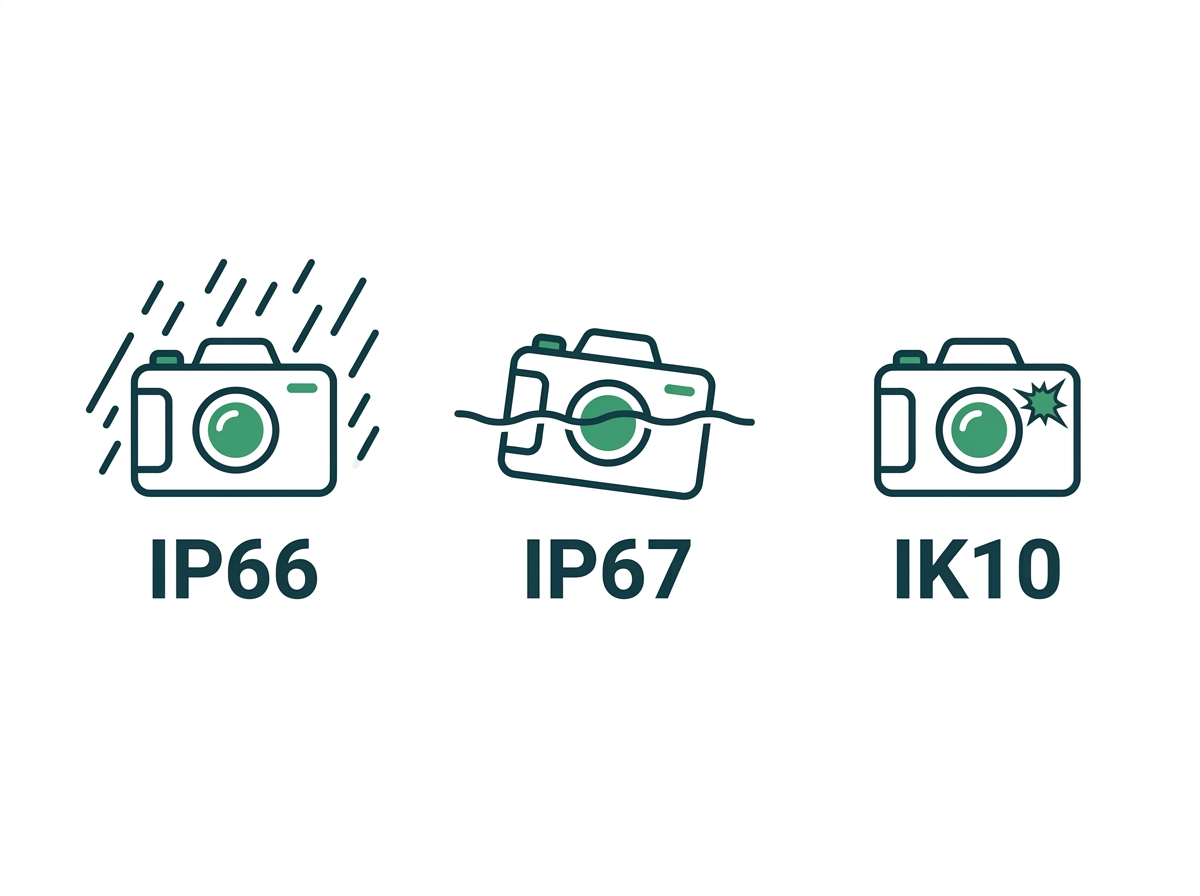
IP66 at minimum outdoors, IP67 for low or flood-prone mounts, and IK10 wherever someone can reach the camera. IP ratings cover water and dust, and IP66 and IP67 are tested against different water hazards rather than ranked against each other. We cover that choice in detail in our breakdown of when IP66 is enough and when IP67 is worth it.
IK10 is a separate impact rating. It means the housing can take a hard knock, which matters for any camera mounted under a low awning or beside a waiting shed.
One thing no rating fixes is an unsealed cable. A camera rated IP67 still fails if water runs down the cable into an open connector, so fit the waterproof cable attachments that come in the box.
What Night Vision Works Best Outdoors?
Color night vision works best outdoors because clothing and vehicle colors are often what an investigation needs. Standard IR records in black and white, which is cheap and works in total darkness but loses those details.
On VIGI ColorPro models like the C340S outdoor bullet, an F1.0 aperture gathers 4 times more light, and a 1/1.8" sensor gives 2.1 times more light-sensitive surface than a standard F2.0, 1/3" setup. The C340S lists minimum illumination as low as 0.0005 lux, so it keeps color in near darkness without a floodlight.
LightPro models take a different route and switch to color with white light only when a person or vehicle appears. Our guide to comparing lux ratings and IR range on night vision cameras goes deeper.
Which Features Should Every Outdoor Camera Have?
Use this list when comparing any two outdoor cameras.
|
Feature |
Why It Matters Outdoors |
What to Look For |
|
Weather rating |
Rain, dust, humidity |
IP66 minimum, IP67 for low or flood-prone mounts |
|
Resolution |
Faces and plates at distance |
At least 2MP, 4MP for most business sites |
|
Night vision |
Half your footage is after dark |
ColorPro or LightPro for color, IR range matched to the scene |
|
WDR |
Bright sky and dark shade in one frame |
120 dB WDR, as on the C340S |
|
Smart detection |
Fewer false alarms from rain and animals |
Human & Vehicle Classification plus line-crossing and intrusion |
|
Compression |
Outdoor scenes move a lot and eat storage |
H.265+ |
|
Power |
Fewer cables and outlets on exterior walls |
PoE |
|
Deterrence |
Stopping incidents, not just recording them |
Active Defense siren and white light |
|
Impact rating |
Cameras within reach |
IK10 |
Smart detection earns its place on that list because outdoor scenes are full of movement that isn't a threat. Here is how smart detection filters rain and animals from outdoor alerts.
How Should You Mount and Cable Outdoor Cameras?
Mount high, seal every entry, and keep water off the lens. Good hardware still fails on a bad install, especially in wet weather.
- Use PoE. One Ethernet cable carries power and data, so there is no outdoor outlet or power adapter to fail in the rain. Our guide to running power and data to cameras over one PoE cable walks through it.
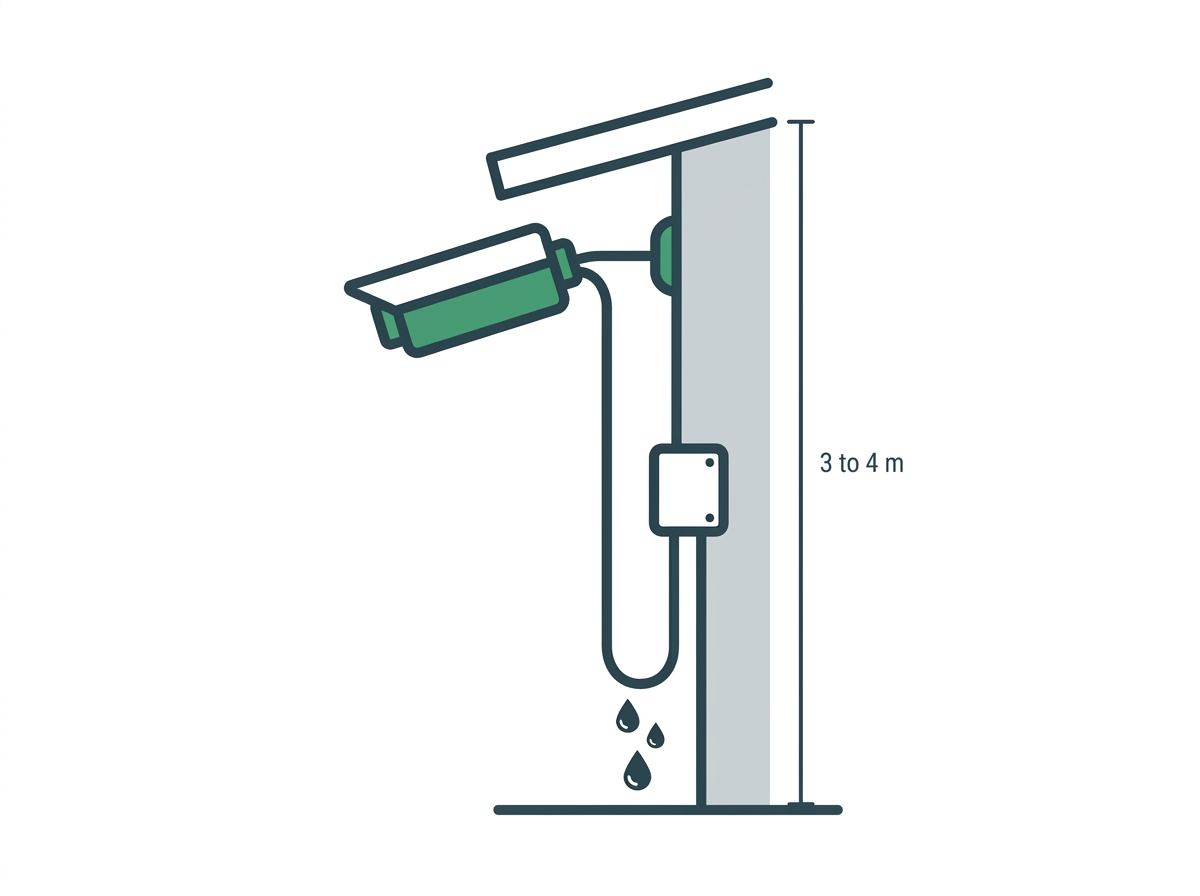
- Mount at about 3 to 4 meters. That keeps the camera out of easy reach while still catching usable facial detail at an entrance.
- Add a drip loop. Let the cable dip below the camera before it rises to the entry point, so water drips off the low point instead of following the cable in.
- Use a junction box. It hides connectors from rain and makes the camera harder to cut loose.
- Mount under an eave when you can. Even an IP67 camera gives cleaner footage when rain isn't streaking across the lens.
- Point away from the sun. East- and west-facing cameras stare into sunrise or sunset. Angle them down or pick a model with strong WDR.
- Protect against surges. Lightning is common in the rainy season, and surge protection on long outdoor runs saves recorder ports.
Frequently Asked Questions
Can I use an indoor camera outdoors under a roof?
Not reliably. A covered porch still gets wind-driven rain during a typhoon, and indoor housings aren't built for humidity, salt air, or wide temperature swings. Moisture tends to fog the lens within months. An outdoor-rated camera costs little more than an indoor one, so use an IP66 or IP67 model anywhere the camera faces open air, even under a deep eave or carport roof.
Can an outdoor camera survive a direct typhoon hit?
The housing usually can, but the mount often can't. IP ratings cover water and dust, not flying debris or a bracket pulled loose by strong gusts. Anchor mounts into concrete rather than plywood or GI sheet, tighten bolts before the typhoon peak, and check each camera's angle after every storm, since a camera knocked a few degrees off can miss the gate entirely.
How close to the sea can I install an outdoor camera?
Anywhere, as long as you plan for salt. Coastal air corrodes exposed screws, brackets, and connectors faster than the camera body itself. Choose a sealed, weather-rated model, fit every waterproof cable attachment, and keep connectors inside a junction box. Resorts and fishponds near the shore should add a quick inspection of brackets and seals to their monthly routine.
Will a white light on my camera bother the neighbors?
Not if you choose the right night vision type. ColorPro cameras keep color in very low light without a floodlight, and LightPro cameras switch their white light on only when they detect a person or vehicle. Aim the camera at your own property and set detection zones inside your boundary, so the light and the recording both stay on your side of the fence.
Can outdoor cameras run without a nearby power outlet?
Yes. PoE cameras take their power through the same network cable that carries video, so the only outlet you need is next to the recorder or switch indoors. For gates, lots, and farm perimeters with no cable route at all, a 4G camera paired with a solar power system removes the need for both power and network lines.
Should I use a bullet or a pan-tilt camera for a parking lot?
Use both if the lot is large. A fixed bullet records the entrance lane around the clock, which matters for plates and timestamps. A pan-tilt camera with automatic tracking follows people and vehicles across the rest of the lot. Relying on a pan-tilt alone risks it pointing the wrong way at the moment something happens at the gate.
Do outdoor cameras need a separate surge protector?
On long cable runs, yes. A lightning strike nearby can send a surge down an outdoor Ethernet cable and damage both the camera and the recorder port it connects to. Short runs under a roof face less risk. For cameras on poles, fences, or rooftops, fit surge protection on the line and put the recorder and switch on a UPS indoors.
Final Thoughts
If you've ever pulled footage after a break-in and found a fogged lens or a black-and-white blur, the camera type was only part of the problem. Long and narrow calls for a bullet. Wide and close calls for a turret. After that, the rating, the night vision, and the install decide whether the camera still earns its keep after two typhoon seasons.
Once you know the type you need, see specific product recommendations for each outdoor camera type. For the bigger picture on resolution, storage, and compliance, read the CCTV System Philippines Buyer's Guide (2026).
Need footage that holds up after dark and in the rain? Compare the VIGI C340S ColorPro bullet and the VIGI C455 full-color turret, then browse every VIGI outdoor bullet and turret camera. To map your exterior before you buy, have a VIGI reseller survey your site.